Stewardship, Care, and Site Preservation at Frank Lloyd Wright’s Historic Pew House
When thinking about legendary architects and designers of the 20th century, the name Frank Lloyd Wright probably rings a bell. From Pennsylvania’s Falling Water to Chicago’s Robie House, Wright has no shortage of recognizable landmarks. Perhaps one of his lesser known designs, though, is the Pew House. Found in the village of Shorewood Hills (Dane County), the home exhibits many of Wright’s architectural ideals on a modest, single-family home scale. Over the past year, Tree House Arbor Science has had the privilege to be involved in the home’s continuing legacy. From a complex tree removal to vegetative and invasive species management, we are excited to highlight our part in a historical space.
Landscape of a Frank Lloyd Wright Home
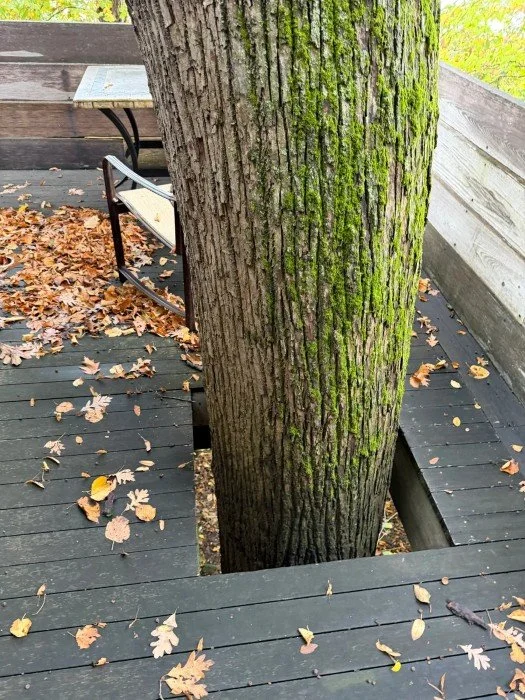
A close look at the integration between home and site
Designed and built between 1938 and1940, the Pew House was created for and inhabited by John and Ruth Pew. Situated on a narrow and very steep lot, the home is perched above a small ravine, and surrounded by trees and foliage. This site was a perfect match for Wright’s organic style of architecture, a hallmark of which is the seamless blending of natural and built environments. The home’s exterior is primarily limestone and untreated cypress, boasting many windows and a large cantilevered deck offering panoramic views of Lake Mendota. Critically, this large deck wraps around an existing Linden tree. The tree rises up and through the home itself. Thought to date to approximately 1938, this linden was one of the reasons Tree House Arbor Science joined the Pew House’s continuing legacy.
The Pew House sits on a sloping lakeside limestone bluff, with a thin soil layer on top. Vegetation and trees play a critical role in retaining that soil layer and reducing erosion. Around four years ago, a storm swept through Madison. A tree on the lakeside limestone banks of the Pew House property was a victim, failing in the storm. Unfortunately, when it went, it took much of the soil and hillside with it. The event highlighted the need for continuing stewardship of this historic home, and further vegetative restoration work to ensure a desirable future for the site. Enter Tree House Arbor Science.
Enter, Tree House
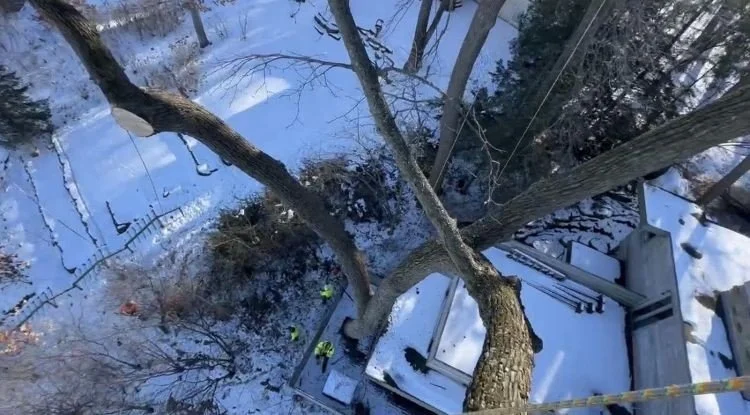
A climbers-eye view of the linden removal
In the summer of 2025, Joe House (ISA Certified Arborist and Tree House Founder) conducted sonic wave testing on over a dozen trees greater than 20 inches in diameter. Sonic testing uses sound waves that travel through the interior of the tree to probes placed on opposing sides. Based on the time it takes these waves to travel between probes, we can determine the structural integrity (or lack thereof) of the tree. This was the first step in formulating a larger plan for restoration on the property. All told, this would result in a property-wide prescription for tree and shrub care. Unfortunately, the first step was to remove the linden that Wright had designed the deck, and much of the house, around.
In January of 2026, Tree House arrived at the Pew House to remove the linden. Given the historic nature of the home, a steep, sloping yard that was covered in snow at the time, and the tree’s position in the deck, this was a challenging removal. Our team was able to draw upon decades of combined training and experience, technical skill, and top notch equipment to perform the work. Co-owner & ISA Certified Arborist, Ryan Altaweel, having used a nearby oak to anchor himself, performed the climbing removal. After setting up a block-and-rope system in the same oak, he was able to rig (lower with ropes) pieces away from the home and into his “drop zone”, where others from the team were waiting to carefully take the pieces up the slope and away from the home. After the tree had been systematically dismantled and removed, the standing stem was cut into small pieces, able to then be lifted up and out of the hole in the deck. We were all sad to see such a statement tree go, but in order to protect the home and to begin our restoration process, the decay found in the base of the tree gave us and the homeowner no alternative.
Technical Removals and Pruning
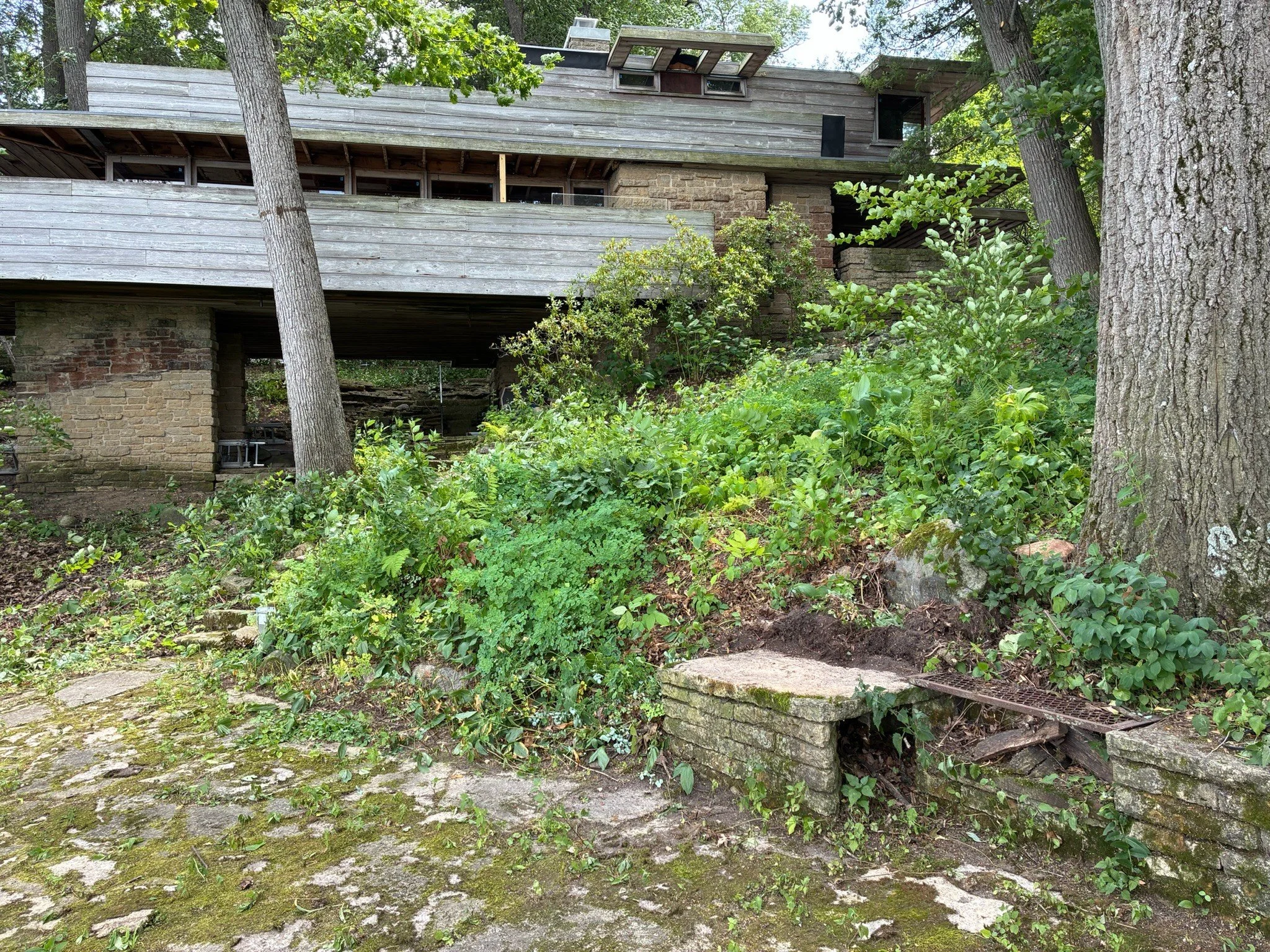
The upper yard, showcasing our vegetative work along the driveway
Though the removal of the linden was the most technically demanding work to be performed at the Pew House, there was still more to be done. Multiple Oaks and Basswood trees were identified as needing pruning treatments. Given the homeowners wishes to keep their property predominantly wooded, most of the work being done aimed to open space in the tree canopies, allowing for wind to blow through the trees rather than pushing them. At Tree House Arbor, we believe the best way to care for trees is to climb them. Therefore, all trees needing pruning were climbed and carefully inspected. Additionally, all were rid of dead wood held in the canopies, and given a treatment known as “end-weight reduction”. This simply means carefully reducing the length of long, horizontal limbs to alleviate the weight and stress that limb is placing on the stem of the tree. These trees, as a result of careful pruning, were ultimately set up to remain on the landscape for a longer period of time, and significantly reduced potential risk to a historic home.
Invasives and Undesireables
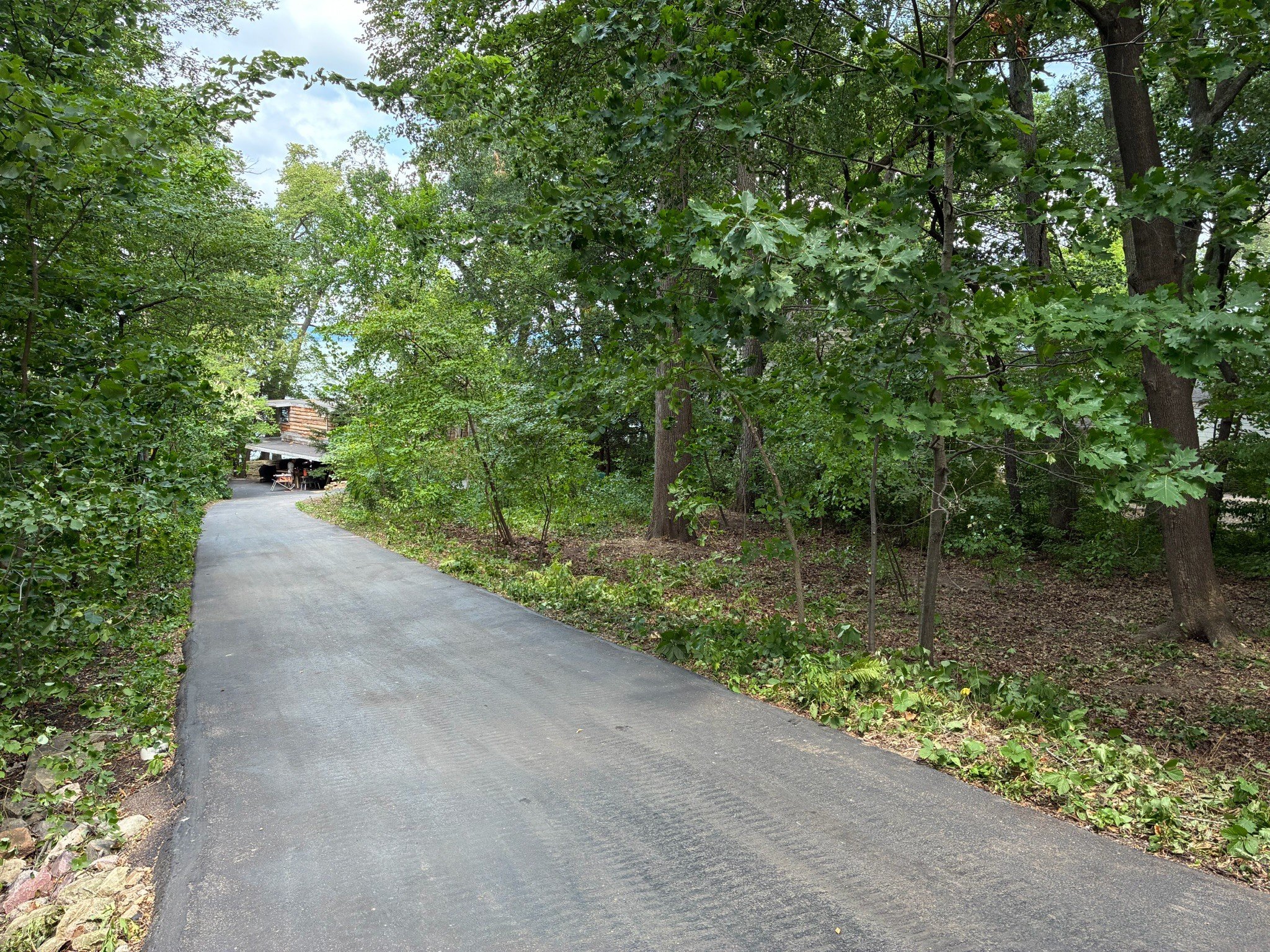
Our product, a managed landscape, optimized for longevity
Lastly, our work included vegetative management, carried out in the summer of 2026. This included extensive removals of invasive and undesirable woody species; buckthorn, European alder, and mulberry, among others. When we began this project, we knew that intentional and precise care was needed. Working with the homeowner, the site was dramatically transformed, and set up for a long term ecologically sound future. We greatly appreciated the chance to help formulate and execute a restoration plan, and enjoy putting our minds to the test with technical removals such as the previously mentioned linden. At a historically significant site, care is the name of the game, and Tree House Arbor Science was proud to have had a hand in the ongoing health and stewardship of such a unique property.
To learn more about how we can work with you to create a plan for your home and property, reach out in whatever form is convenient for you. We look forward to working with you!