Preventing Tree Storm Damage
The Best Storm Damage Is the Kind That Never Happens
STORM PREPAREDNESS & TREE CARE — MADISON, WISCONSIN
ISA Certified Arborists · Tree House Arbor Science · Madison, Wisconsin · TCIA Member Company
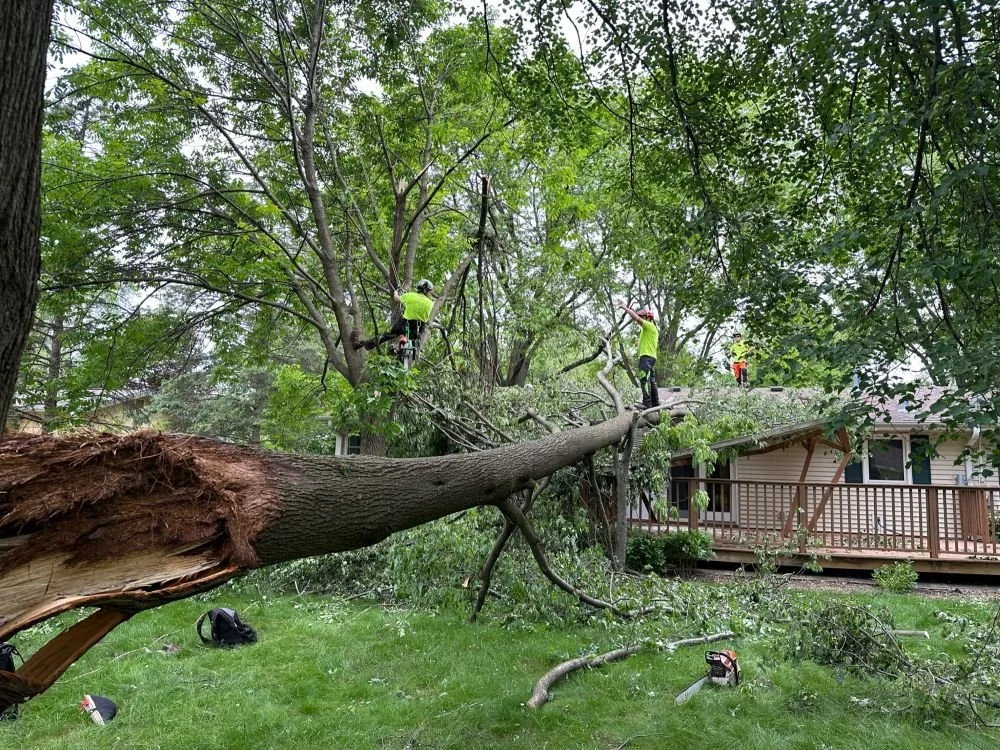
When a tree comes down on a home, the clock is ticking. Our crews respond quickly, but the goal is always to prevent situations like this before they happen.
If you've lived in Madison for a few years, you've probably seen what a bad storm can do to a neighborhood. A large branch through a roof. A whole tree across a driveway. A beautiful old oak, one that a family watched grow for decades, split down the middle and gone in a night. These things happen. But they don't always have to.
The honest truth is that most serious storm damage to trees is predictable. Dead branches, overextended limbs, weakened branch unions, and unbalanced canopies are all conditions that an arborist can identify and address long before a storm arrives. We started Tree House Arbor Science because we believe that proactive tree care is the single most effective thing a Madison homeowner can do to protect their property from weather-related tree damage. What follows is a plain-language guide to what that care looks like and why it matters.
Start with a proper look at what you have
Before we touch a tree, we walk the property and take a careful look at each one. We're evaluating the overall shape and balance of the canopy, looking for dead or hanging branches, checking for decay at the trunk and major limbs, and paying close attention to places where two large stems grow together. Those junctions are often the first to fail in a storm.
This kind of assessment, grounded in ISA tree risk evaluation guidelines, helps us understand which trees are genuinely storm-ready and which ones have vulnerabilities that need attention. We can then give you an honest picture of where the risks are and what can be done about them before the next ice storm or microburst makes those decisions for you.
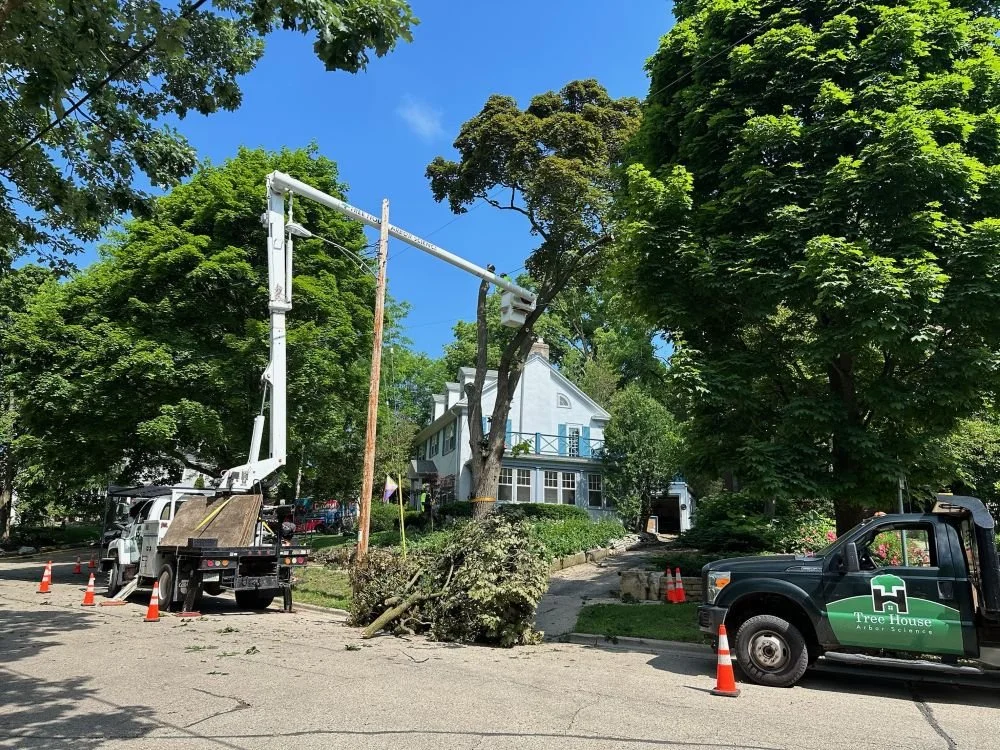
A Tree House Arbor Science crew at work on a Madison residential street. Every job is led by one of our owner arborists, ensuring the right decisions get made at every step.
Removing dead branches is critical and part of a complete plan
Deadwood removal is one of the most important services we perform, and for good reason. Dead branches don't bend in the wind the way living wood does. They snap and they fall. A dead limb over your roof, your driveway, or your backyard where kids play isn't just an eyesore. It's a hazard waiting for the right gust to become a problem. Wisconsin's ice storms and wind events make this especially urgent; a dead branch that might hold on through a calm summer can come down fast when ice builds up on it.
When we remove dead branches, we make each cut just outside the natural ring of tissue at the base of the branch, which allows the tree to seal over the wound on its own. Done properly, it's clean, effective, and sets the tree up for healthy growth going forward.

One of our arborists climbing a large Madison tree for structural assessment and pruning. We climb every tree we work on — the view from inside the canopy is the only way to truly evaluate it.
Deadwood removal is one essential part of a complete care plan, but not the whole thing. Just as important is ongoing structural pruning that shapes the tree's architecture over time. A tree that's regularly pruned for good structure is fundamentally more resilient than one that's only had dead branches removed. We treat both as equally important pillars of storm-ready tree care.
Structural pruning builds storm-resilient trees over time
Structural pruning is about shaping how a tree grows so that it becomes more stable and balanced over time. For young trees, this means guiding growth early so that problems don't develop in the first place. For mature trees, it means making thoughtful decisions about which branches to keep, which to shorten, and how to maintain a canopy that distributes weight and wind load evenly.
One of the most common structural problems we see in Madison's neighborhoods, especially in the large silver maples and cottonwoods that are so prevalent here, is long, heavy limbs that have grown well out from the trunk. These branches put enormous stress on their attachment points. A technique called end weight reduction pruning addresses this by carefully shortening extended branches back to a smaller branch growing in the right direction. The result is a limb that's lighter, better balanced, and far less likely to fail when the canopy fills with leaves and the wind picks up.
Think of it like trimming the sails before a storm. The tree stays whole and healthy and it's better prepared for what's coming. Structural pruning also keeps an eye on the overall balance of the canopy. A tree that's heavily weighted to one side, or that has one dominant limb extending far over a structure, carries more risk in high winds than a tree with a balanced, open crown. We account for this when we plan our pruning. We don’t just remove what looks wrong, we think ahead to where the tree is going and how we can help it get there safely.
Steel cable support systems for trees that need extra help
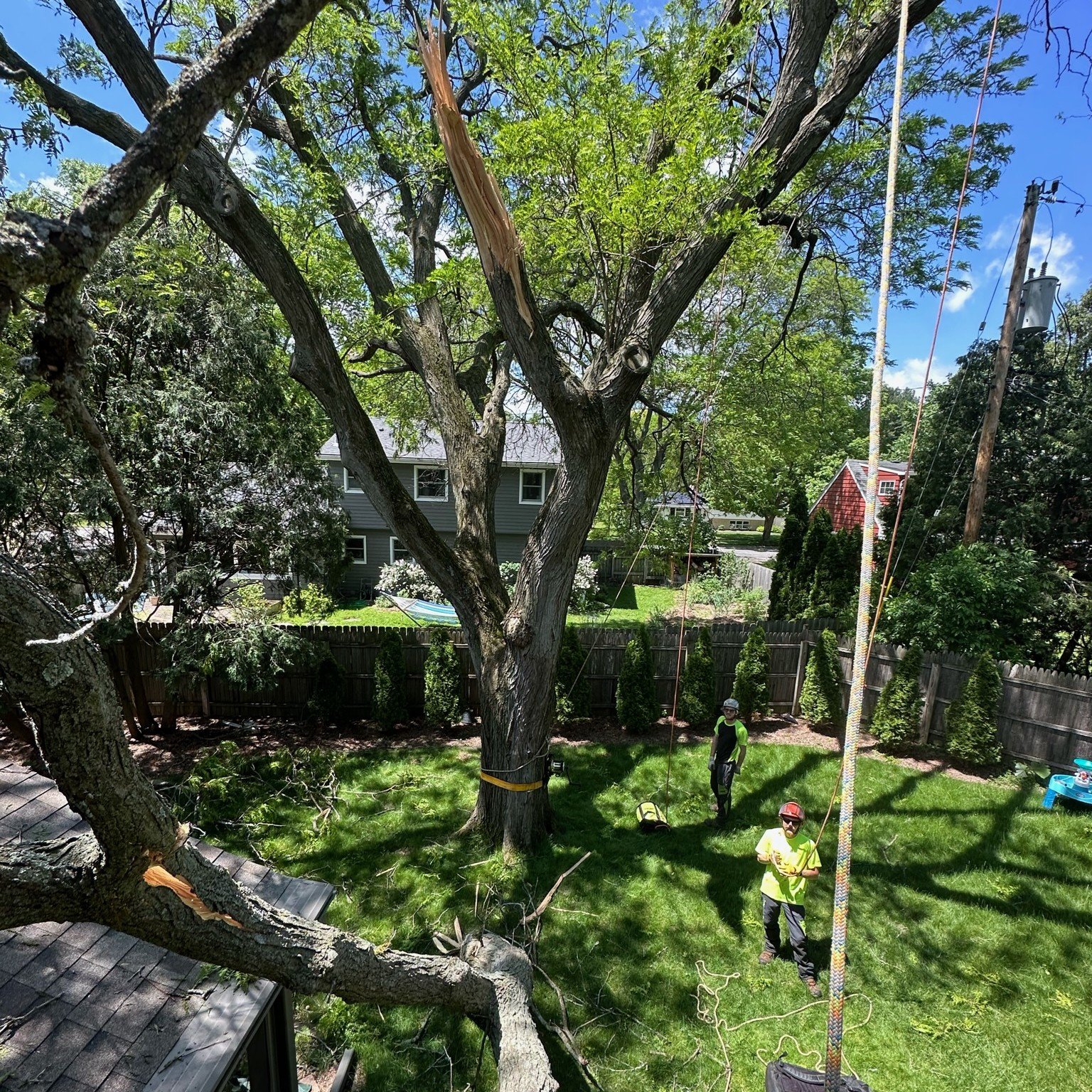
Our crew rigging a storm-split tree for controlled removal in a tight Madison backyard. This is exactly the kind of failure a properly installed cable system is designed to prevent.
Some trees have a structural situation that pruning alone can't fully fix. Two large stems growing from a single trunk. A heavy branch with a tight, strained attachment angle. A union that's beginning to show a crack. These are trees that benefit from a steel cabling system. This is a way of mechanically supporting a vulnerable part of the tree's structure so it can withstand the forces that storms generate.
A steel cable system works by connecting two parts of the tree, typically the two stems or limbs at risk of splitting, with a strong steel cable anchored securely into the wood. We install the cable in the upper portion of the canopy, generally about two-thirds of the way up from the problem area toward the top of the tree, where it can most effectively limit the movement between the two anchor points. We use extra-high-strength steel cable and through-hardware fastened so it won't loosen over time, following ANSI A300 cabling standards throughout.
This type of system is particularly valuable when a tree is showing early signs of stress like a slight crack at a union, or a stem that shifts visibly in high winds. The cable limits how far those two parts of the tree can move apart from each other, reducing the risk of a catastrophic split during a storm. It's not a cure for every problem, and it doesn't replace good pruning, but for the right tree in the right situation, it can be the difference between losing a tree and keeping it for another generation. Every cabled tree we install gets a regular inspection to make sure the hardware is secure and doing its job as the tree continues to grow.
“A note on cable systems: A cable system should always follow a thorough structural assessment that identifies the specific problem being addressed. If a contractor wants to cable a tree without explaining exactly where, why, and how, that’s a red flag. Cabling done right, according to ANSI standards by trained arborists, is a proven tool. Cabling done carelessly isn’t worth much to you or your tree.”
Two things we will never do
We get calls from Madison homeowners who've had tree work done and something looks wrong. There’s strange die-back, a canopy that looks skeletal in the middle, or stubs where big branches used to be. In most cases, what we're seeing is the result of one of two practices that remain common in the industry despite being genuinely harmful.
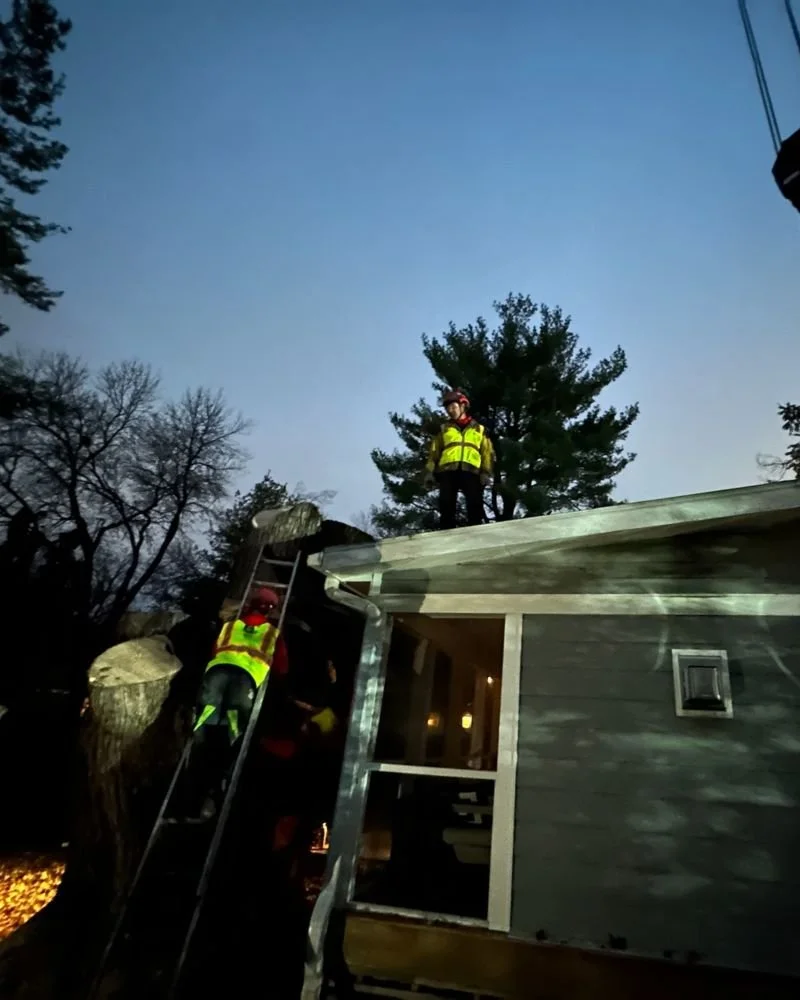
Our team doesn’t stop when the sun goes down. When a tree comes through a roof, we’re there, day or night. But the work we’d always rather be doing is the kind that prevents this from happening in the first place.
The first is topping — cutting the main stems of a tree down to flat, blunt stubs in order to make the tree shorter. It seems logical on the surface, but those large stubs can't heal properly, which invites decay. The tree responds by sending up a cluster of fast-growing, weakly attached new shoots from just below each cut. Those shoots grow quickly back to the original height, but with worse structure and more risk than before the topping ever happened. The ISA is clear on this: topping is not acceptable tree care. If a tree is too large for its location, there are proper reduction techniques we can use. Topping is not one of them.
The second harmful practice is lion's-tailing — stripping the interior branches out of a canopy so that foliage is concentrated only at the tips of the limbs. Some contractors describe this as thinning, but it does the opposite of what good thinning is supposed to accomplish. When interior growth is removed, all of the canopy's weight sits at the very ends of long branches. That makes those branches significantly more vulnerable to failure in a storm, which is exactly the outcome we're trying to prevent. Proper thinning distributes removals throughout the entire canopy, preserves interior growth, and leaves a tree that's lighter and more flexible in wind, not more brittle.
“WATCH FOR THESE RED FLAGS
If a contractor proposes topping your trees, or their work leaves your canopy thin in the middle and bushy only at the tips, they are not following professional standards and your trees will be less storm-safe afterward, not more. Always ask for ISA certification and proof of insurance before any work begins. ”
The weather isn't getting easier and your trees can be ready for it
Storms in the Madison area have become less predictable and more intense in recent years. The super-cell that tore through southern Wisconsin, the ice storms that have snapped branches across entire neighborhoods, and the summer microbursts that seem to come out of nowhere aren't rare exceptions anymore. They're part of living here. And the trees on your property are going to face them.
The good news is that well-maintained trees are genuinely more resilient. A tree with a clean, balanced canopy, no dead wood, good structural form, and, where needed, a properly installed cable system can weather a serious storm without becoming a crisis on your property. That resilience doesn't happen by accident. It's the result of regular attention by people who know what to look for.
At Tree House Arbor Science, we've been caring for Madison's trees since 2011. We climb every tree we work on with no guesses from the ground. We evaluate each tree up close, prune only what needs pruning, and talk with you honestly about what we find. If your trees are in good shape, we'll tell you. If something needs attention, we'll explain exactly what it is and why it matters.
If you have trees you're not sure about or trees that worry you before every big storm, reach out and schedule a free consultation. We'll take a look, give you a straight answer, and help you get ahead of whatever weather comes next.
Tree House Arbor Science — Madison, Wisconsin
Call or text: (608) 234-5935
Email: sales@treehousearborscience.com
Request a free consultation: www.treehousearborscience.com/request-quote
Written by the ISA-certified arborists at Tree House Arbor Science, 1720 Capital Ave., Madison, WI 53705. Tree House Arbor Science is a Tree Care Industry Association member company and a member of the Wisconsin Arborist Association and the International Society of Arboriculture. All recommendations follow ISA Best Management Practices, ANSI A300 Tree Care Standards, and ANSI Z133 Safety Standards for Arboricultural Operations. Static cabling system guidance informed by Jones & Greenwood, "An Introduction to Supplemental Tree-Support Systems, Part 2," TCI Magazine (2024).